Past Events
Institutions in Motion: Democracy Between Social Struggle and the State
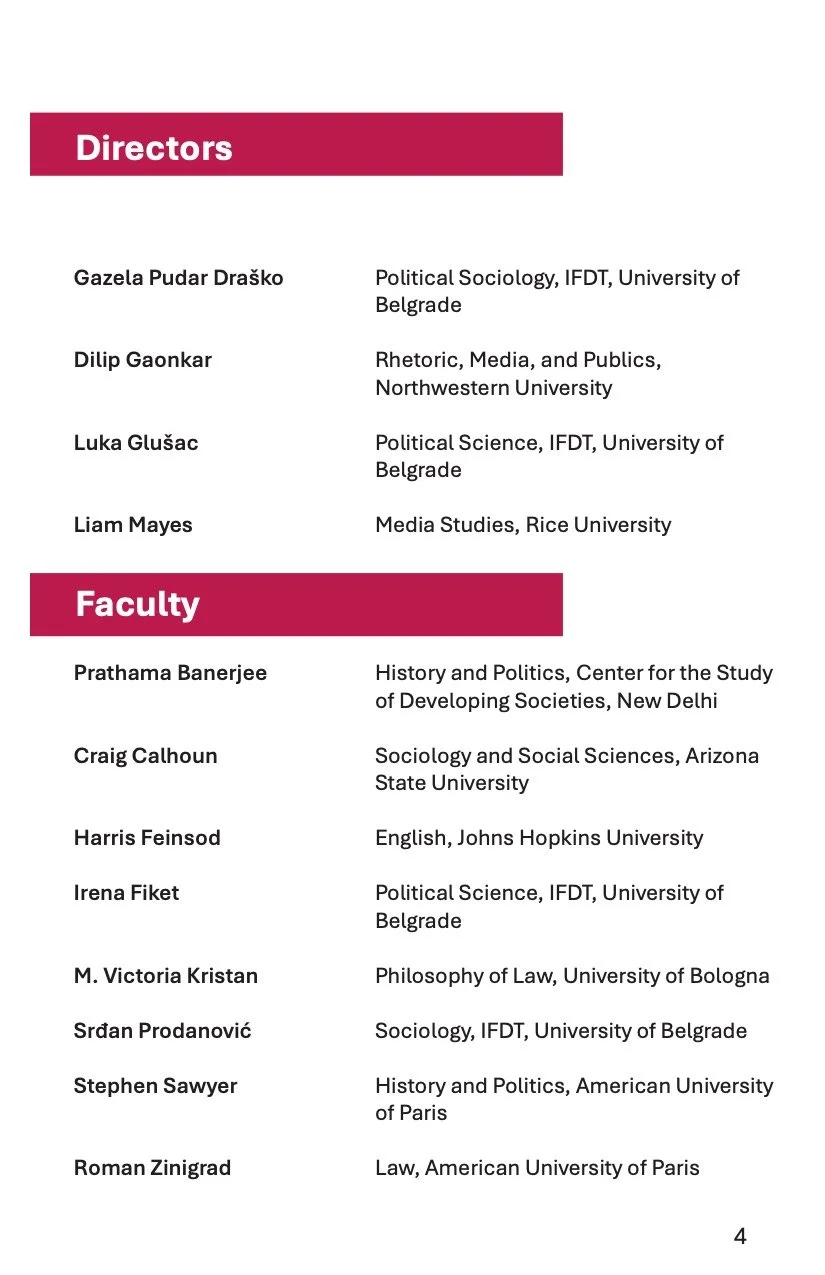
Institute for Philosophy and Social Theory, University of Belgrade, Belgrade, June 29 - July 4, 2026

Course Overview
From long-established democracies to rising autocracies, democratic citizens are losing faith in their institutions. Courts, parliaments, regulatory agencies, public universities, and public administrations are increasingly perceived as captured, hollowed out, or disconnected from the social and political worlds they are meant to sustain.
Under the pressures of vast economic inequality, volatile nationalisms, crumbling state infrastructure, massive technological disruption, consolidating corporate power, and an unfolding global climate catastrophe, we are turning to democracy’s institutions with anxiety, skepticism, and even with suspicion. This institutional crisis is a sign of eroding political trust and one of the causes of intensifying democratic fragility. Yet it has also generated a demand: not for the abandonment of democratic institutions, but for their reconstruction, re-legitimation, and renewal. Rather than treating institutions as fixed containers of political life or as outcomes of elite design, this course approaches them as historical and political achievements, shaped through conflict, mobilization, negotiation, and collective imagination.
The central focus of the course is the open question of what potential democratic institutions hold for responding to the political challenges of the twenty-first century. How are claims articulated in the language of protest, resistance, and social justice transformed into durable institutions? When do bottom-up initiatives succeed in producing institutions that are both democratically legitimate and practically effective? How are democratic institutions failing: through cooptation, bureaucratic neutralization, or repression? How can institutions remain open to contestation without losing their capacity to govern? Amid polarized publics, contested rights regimes, and declining trust, how can democratic institutions be restored? By foregrounding institution (re)building as a democratic practice, the course challenges both technocratic and anti-institutional responses to democratic decline. The course will employ an interdisciplinary perspective and global scope, comparing democratic contexts across time and space. To this end, the course will foster a robust dialogue among students, activists, legal professionals, and scholars assembled from all over the world.
Ultimately, participants will leave the course with a new understanding of democracy as the ongoing work of constructing institutions capable of channeling conflict, sustaining trust, and enabling collective self-rule.
Student participants
Paweł Bącal, European University Institute; Calvin Bell III, Northwestern University; Suhash Bhattacharjee, National Institute of Technology Silchar; Elena Čavlin, University of Belgrade; Andjela Djordjevic, University of Ljubljana; Iva Đolović, University of Belgrade; Rebecca Duras, University of Niš; Jaikirti Havlick, Arizona State University, Mina Ilić, University of Belgrade; Aleksandar Ivković, University of Belgrade; Olugbenga Joseph, Northwestern University; Prerna Khobragade, Northwestern University; Melek Kılıçgedik, İstanbul Nişantaşı University & Marmara University; Keti Kvizhinadze, University of Siena; Elda Marku Aleksandër, Moisiu University; Igor Muidža, University of Belgrade; Jay Nelson, Northwestern University; Goran Novaković, University of Belgrade; Kristina Rishko, HSE University (Higher School of Economics); Nahum Shemi, Rice University; Marina Slhessarenko Barreto, University of São Paulo; Helena Stolnik Trenkic, University of Cambridge; Yejia Sun, Northwestern University; Elena Trajkovska, Goce Delcev University; Mounica Sreesai Vegi, Northwestern University; Tong Yi, École Normale Supérieure-PSL; Ammar Zafar, University of Liverpool.
Ecology, Capitalism, Democracy
Central European University, Budapest, Hungary, July 14–19, 2025
Course Directors
Rhetoric and Public Culture, Northwestern University, Evanston, USA
Politics, Law and Social Thought, Rice University, Houston, USA
Shalini Randeria
Central European University, Vienna, Austria/Budapest, Hungary
Course Faculty
Centre for the Study of Developing Societies, Delhi, India
Political and Social Sciences, Universitat Pompeu Fabra, Barcelona, Spain
Social Sciences, Arizona State University, Tempe, USA
Environmental Humanities, Rachel Carson Center for Environment and Society, Ludwig Maximilians University Munich, Germany
Department of English, Johns Hopkins University, Baltimore, USA
Department of the History of Consciousness, University of California, Santa Cruz, USA
Political Science, University of Copenhagen, Denmark
Department of Sociological Theory, University of Barcelona, Spain

Course overview
There are typically two ways to explain how and why democracies die. The first kind of explanation, which was dominant for much of the twentieth century and has returned with Russia’s invasion of Ukraine, turns to external threats. The second kind of explanation, which secured its dominance after the fall of the Soviet Union and the apparent triumph of a global liberal democratic order, turns to internal tensions—from religious violence to government corruption to tyrannical majorities to authoritarian take-over.
This course explores an increasingly urgent third kind of explanation. In addition to external threats and internal tensions, democracies now face challenges that are neither strictly internal nor external but global, systemic, and infrastructural. We understand these challenges under two broad categories: the unfolding ecological crises and the catastrophes wrought by capitalism’s intensification. Can democracy, a mode of governance bound by national borders, respond to these boundless global, systemic, and infrastructural challenges? What is the relationship between ecological and capitalist crises? How do ecological and capitalist crises animate democracy’s internal and external antagonists?
The aim of the course is to re-examine the relationship between democracy, ecology, and capitalism by attending to the complex and diverse challenges democratic societies are navigating today. The course will employ an interdisciplinary perspective and global scope, comparing democratic contexts across time and space. To this end, the course will foster a robust dialogue among students, activists, and scholars assembled from all over the world. Students will leave the course with a deeper understanding of democracy’s modern challenges as well as new questions and ideas about how they may be productively addressed
Student participants
Incha Aliyeva, Baku State University; Margaret Allan, Northwestern University; Priyanka Bharti, Jawaharlal Nehru University; Anjor Bhaskar, Azim Premji University; Allani Dye, Northwestern University; Emanuele Faccion, Leiden University; Puji Hastuti, Indonesian Institute of Sciences; Jaik Havlick, Arizona State University; Ifra Javed, Northwestern University; Charles Kleinfeld, University of Leeds; Thea Kleinrath, Karlshochschule International University; Roberta Koleva, Central European University; Milan Loewer, Columbia University; Mohanan Manasi, University of Hyderabad; Yver Melchor, Metropolitan Autonomous University; Behailu Shiferaw Mihirete, Northwestern University; Palesa Nqambaza, University of Johannesburg; Aditi Patil, University of Cambridge; Somaieh Samimi, Shahid Beheshti University; Chris Shafuda, University of Namibia; Attila Szabó, University of Szeged; Mario Ulloa, Northwestern University; Veena Vijayan A. V., Jawaharlal Nehru University; Jakub Wydra, Jagiellonian University in Kraków.
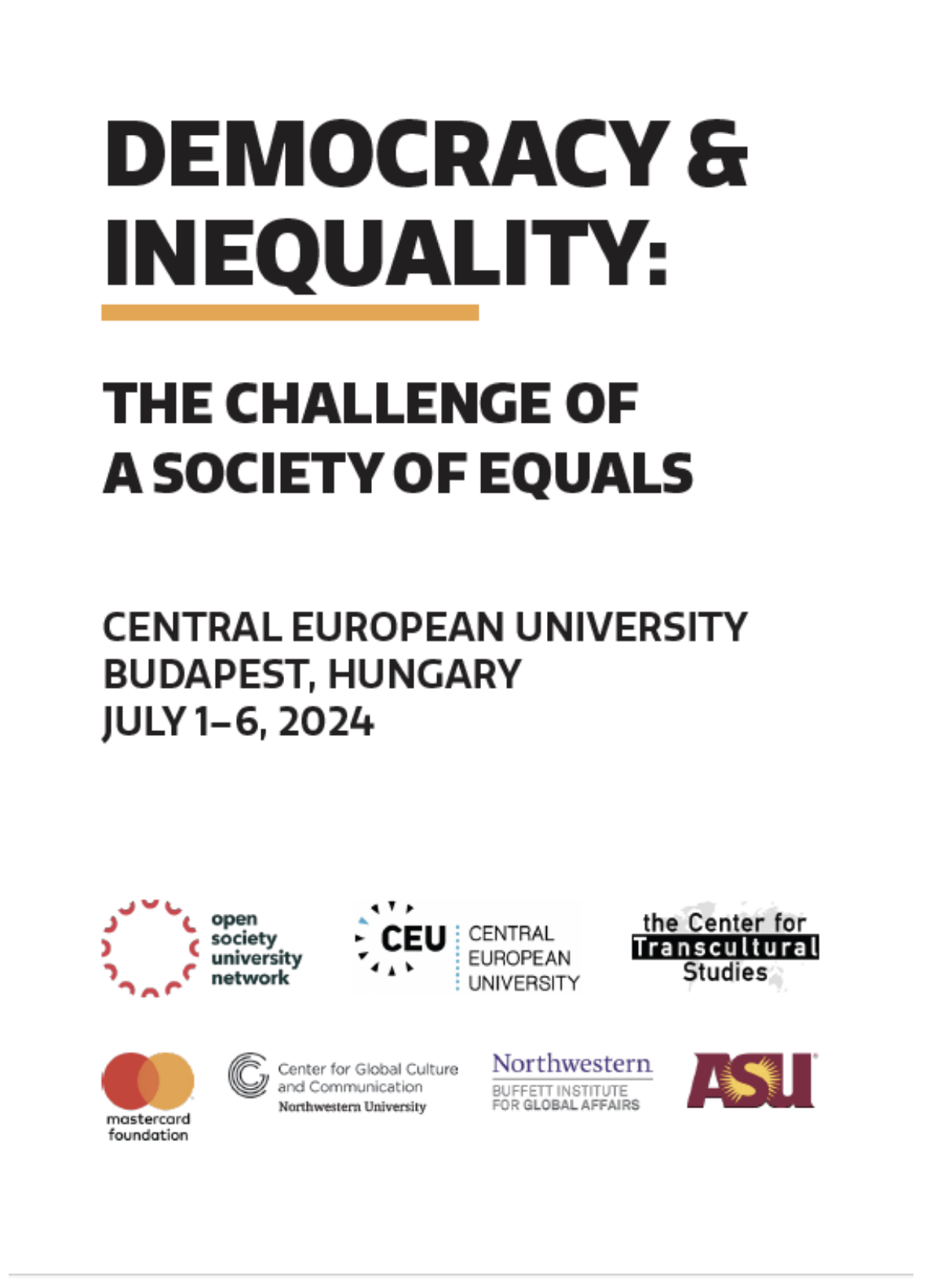
Democracy and Inequality: The Challenge of a Society of Equals
Central European University, Budapest, Hungary, July 1–6, 2024
Course Directors
Dilip Gaonkar
Rhetoric and Public Culture, Northwestern University, Evanston, USA
Shalini Randeria
Central European University, Vienna, Austria/Budapest, Hungary
Course Faculty
Banu Bargu
History of Consciousness, University of California-Santa Cruz, USA
Prathama Banerjee
Centre for the Study of Developing Societies, Delhi, India
Craig Calhoun
Social Sciences, Arizona State University, Tempe, USA
Liam Mayes
Politics, Law and Social Thought, Rice University, Houston, USA
José Medina
Philosophy, Northwestern University, Evanston, USA
Sofia Näsström
Department of Government, Uppsala University, Sweden
Charles Taylor
Philosophy, Emeritus, McGill University, Montreal, Canada
Massimiliano Tomba
History of Consciousness, University of California, Santa Cruz, USA
Nadia Urbinati
Political Science, Columbia University, New York, USA

Course Overview
There are typically two ways to explain how and why democracies die. The first kind of explanation, which was dominant for much of the twentieth century and has returned with Russia’s invasion of Ukraine, turns to external threats. The second kind of explanation, which secured its dominance after the fall of the Soviet Union and the apparent triumph of a global liberal democratic order, turns to internal tensions—from religious violence to government corruption to tyrannical majorities to authoritarian takeover. This course explores an increasingly urgent third kind of explanation. In addition to external threats and internal tensions, democracies now face challenges that are neither strictly internal nor external but global, systemic, and infrastructural. We understand these challenges under two broad categories: the unfolding ecological crises and the catastrophes wrought by capitalism’s intensification.
Can democracy, a mode of governance bound by national borders, respond to these boundless global, systemic, and infrastructural challenges? What is the relationship between ecological and capitalist crises? How do ecological and capitalist crises animate democracy’s internal and external antagonists?
The aim of the course is to re-examine the relationship between democracy, ecology, and capitalism by attending to the complex and diverse challenges democratic societies are navigating today. The course will employ an interdisciplinary perspective and global scope, comparing democratic contexts across time and space. To this end, the course will foster a robust dialogue among students, activists, and scholars assembled from all over the world. Students will leave the course with a deeper understanding of democracy’s modern challenges as well as new questions and ideas about how they may be productively addressed.
Co-Sponsors
Central European University, the Open Society Foundations, the Center for Global Culture and Communication (Northwestern University’s School of Communication), and the Buffett Institute of Global Affairs (Northwestern University, Evanston, USA).
Student Participants
Rod Abhari, Northwestern University; Jinxue Chen, Northwestern University; Wei-Chung Chen, Charles University; Elise De Los Santos, Northwestern University; Carolina Falcão, University of Pernambuco; Ivy Flessen, Duke University; Jacob Goodman-Palmer, Northwestern University; Sidiqa Kamran, American University of Central Asia; Mostafa Khalili, Kyoto University; Thahir Jamal Kiliyamannil, University of Hyderabad; Roberta Koleva, Central European University; Pavlo Kostin, Central European University; Swadesh Kumar, Jawaharlal Nehru University; Wenwen Li, University of Wisconsin-Madison; Milan Loewer, Columbia University; Chengfei Mao, Nankai University; Nicole Mayberry, University of Arizona; Rejitha Nair, NALSAR University of Law; Mosupatsila Nare, University of Pretoria; Alex Olivares, Central European University; Juan Pablo Patitucci, University of Buenos Aires; Sajad Rasool, University of Peshawar; Joseph Rodriguez, Northwestern University; Bipin Sebastian, Northwestern University; Salome Shonia, Central European University; Margaret Solace, Northwestern University; Khampha Stempel, Arizona State University; Berkant Yavuz, Central European University.
It Takes a Movement:
Social Mobilization and Rebuilding Democracy
Central European University, Budapest, Hungary. July 3–9, 2023
Course Directors
Dilip Gaonkar
Rhetoric and Public Culture, Northwestern University, Evanston, USA
Shalini Randeria
Central European University, Vienna, Austria/Budapest, Hungary
Course Faculty
Prathama Banerjee
Centre for the Study of Developing Societies, Delhi, India
Humberto Beck
International Studies, El Colegio de México, Mexico City, Mexico
Craig Calhoun
Social Sciences, Arizona State University, Tempe, USA
Ulrike Flader
Anthropology, University of Bremen, Germany
Lisa Guenther
Philosophy, and Critical Prison Studies, Queen’s University, Kingston, Canada
Aishwary Kumar
Ahimsa Center, History, College of Letters, Arts, and Social Sciences, California State Polytechnic University, Pomona, USA
Charles Taylor
Philosophy, McGill University, Montreal, Canada
Lars Tønder
Political Science, University of Copenhagen, Denmark
Camil Ungureanu
Political and Social Sciences, Universitat Pompeu Fabra, Barcelona, Spain
Course Faculty Coordinator
Liam Mayes
Communication and English, Tulane University, New Orleans, USA
Course Overview
Around the world, democracies are breaking down. Many are being dismantled from within while others face attacks from without. In both cases, the issues underlying democracy’s erosion are not superficial but deeply entrenched and complex. As a result, democracies will not be renewed without considerable effort. Technical fixes imposed from above may slow democratic degeneration, but they cannot reverse it. Rebuilding democracy—fortifying its institutions and advancing its project—takes a movement from below.
Yet, when it comes to social mobilization, democratic societies tend to be apprehensive. A handful of exceptionally civil, organized, and focused social movements may serve as evidence of a dynamic public sphere and a healthy democratic culture. But far more often, democratic governments respond to social mobilization with less enthusiasm, treating it as anything from a nuisance to a threat. After all, what democratic purpose could social mobilization fulfill in a society with fair elections, democratic representation, and independent courts? Given the growing frequency, intensity, scale, and volatility of twenty-first century social mobilizations in democratic societies, it is difficult to see them simply as a confirmation of democratic flourishing or evidence of its undoing. Instead, from Indian farmers to Canadian truckers and Colombian taxpayers, from the Black Lives Matter movement to the Yellow Vests, these mobilizations index social, political, cultural, and economic crises that democratic governments have failed to address. In this context, what is the relationship between social mobilization and democracy? Do loosely networked local protests in disparate contexts share a global anatomy? When are social mobilizations a threat to democracy and when are they the foundation of its renewal?
The aim of It Takes a Movement is to re-examine the relationship between social mobilization and democracy by attending to the stunning complexity and diversity of twenty-first-century protests and social movements. The course will employ a global perspective, comparing social mobilizations across different democratic contexts, tracing transnational connections and fissures, and establishing common features. To this end, the course will foster a robust dialogue among students, activists, and scholars assembled from all over the world. Students will leave the course with a deeper understanding of the fraught relationship between democracy and social mobilization as well as new questions and ideas about how it might be productively addressed.
The course will fund a minimum of twenty students and reserves one-third of available spaces for applicants from Africa, Asia, and Latin America.
Co-Sponsors
Central European University, Open Society University Network (OSUN), Mastercard Foundation, and Center for Global Culture and Communication (Northwestern University), in collaboration with Arizona State University.
Student participants
Maria Arievitch, Brown University; Oliver Barker-Vormawort, University of Cambridge; Federico Dupont Bernal, Universidad de los Andes; Ryan Bince, Northwestern University; Justin Bouteloup, École Normale Supérieure de Lyon; José Correa-Cabrera, Central European University; Eva Rubens Célem, Northwestern University; Ahana Chakrabarti, Jadavpur University; Skylar Clark, Northwestern University; Gonzalo Galindo Delgado, Arizona State University; Dasanayaka Dissanayake, Centre for Monitoring Election Violence; Haoran Duan, Peking University; Saraí Elizondo, Centro de Investigación y Docencia Económicas; Nora Eörsi, Friedrich Schiller University Jena; Zhea Katrina Estrada, University of Santo Tomas; Bolanle Kemisola Falade, Federal University of Oye-Ekiti; Mostafa Khalili, Chiba University; Sadia Mahmood Falki, Lahore College for Women University; Lusine Grigoryan, Freie Universität Berlin; AJ Kurdi, University of California, Berkeley; Enrico Maria la Forgia, University of Padua; Chinglen Laishram, Central University of Gujarat; Siyum Adugna Mamo, Ghent University; Akudo McGee, Maastricht University; Noran Mohamed, Northwestern University; Camila Páez Bernal, Arizona State University; Rahul Ranjan, Oslo Metropolitan University; Marko Saranovic, Graduate Institute of International and Development Studies; Shohreh Shafiee, Tarbiat Modares University; Sanuri Trikawalagoda, Arizona State University; Nan Wakefield, University of Kentucky; Luna White, Northwestern University.
Course guests
Carolyn Forbes, Assistant Director, Center for Work and Democracy, Arizona State University; Lipin Ram, Soft Authoritarianism Project, University of Bremen; Hagen Steinhauer, Soft Authoritarianism Project, University of Bremen
Dismantling Democracy from Within
Central European University, Budapest, Hungary. June 27–July 2, 2022
Course Directors
Dilip Gaonkar
Rhetoric and Public Culture, Northwestern University, Evanston, USA
Shalini Randeria
Central European University, Vienna, Austria/Budapest, Hungary
Course Faculty
Prathama Banerjee
Centre for the Study of Developing Societies, Delhi, India
Craig Calhoun
Social Sciences, Arizona State University, Tempe, USA
Eva Fodor
Gender Studies/Inequalities and Democracy, Democracy Institute, Central European University, Vienna, Austria/Budapest, Hungary
Nilüfer Göle
Sociology, École des hautes études en sciences sociales, Paris, France
Charles Taylor
Philosophy, McGill University, Montreal, Canada (Emeritus)
Nadia Urbinati
Political Science, Columbia University, New York, USA
Course Faculty Coordinator
Liam Mayes
Communication, Tulane University, New Orleans, USA
Course Overview
Around the world, democracies are breaking down. Many are being dismantled from within while others face attacks from without. In both cases, the issues underlying democracy’s erosion are not superficial but deeply entrenched and complex. As a result, democracies will not be renewed without considerable effort. Technical fixes imposed from above may slow democratic degeneration, but they cannot reverse it. Rebuilding democracy—fortifying its institutions and advancing its project—takes a movement from below.
Yet, when it comes to social mobilization, democratic societies tend to be apprehensive. A handful of exceptionally civil, organized, and focused social movements may serve as evidence of a dynamic public sphere and a healthy democratic culture. But far more often, democratic governments respond to social mobilization with less enthusiasm, treating it as anything from a nuisance to a threat. After all, what democratic purpose could social mobilization fulfill in a society with fair elections, democratic representation, and independent courts? Given the growing frequency, intensity, scale, and volatility of twenty-first century social mobilizations in democratic societies, it is difficult to see them simply as a confirmation of democratic flourishing or evidence of its undoing. Instead, from Indian farmers to Canadian truckers and Colombian taxpayers, from the Black Lives Matter movement to the Yellow Vests, these mobilizations index social, political, cultural, and economic crises that democratic governments have failed to address. In this context, what is the relationship between social mobilization and democracy? Do loosely networked local protests in disparate contexts share a global anatomy? When are social mobilizations a threat to democracy and when are they the foundation of its renewal?
The aim of It Takes a Movement is to re-examine the relationship between social mobilization and democracy by attending to the stunning complexity and diversity of twenty-first-century protests and social movements. The course will employ a global perspective, comparing social mobilizations across different democratic contexts, tracing transnational connections and fissures, and establishing common features. To this end, the course will foster a robust dialogue among students, activists, and scholars assembled from all over the world. Students will leave the course with a deeper understanding of the fraught relationship between democracy and social mobilization as well as new questions and ideas about how it might be productively addressed.
The course will fund a minimum of twenty students and reserves one-third of available spaces for applicants from Africa, Asia, and Latin America.
Co-Sponsors
Central European University, Open Society University Network (OSUN), Mastercard Foundation, and Center for Global Culture and Communication (Northwestern University), in collaboration with the Arizona State University
Student participants
Simone Benazzo, Université libre de Bruxelles; Emma Brandt, Northwestern University; Virgil Brower, Charles University; Becky Brown, University of Edinburgh; Rahime Çokay Nebioğlu, Duke University; Ahmed T. Elbasyouny, Indiana University; Taylor Genovese, Arizona State University; Sayori Ghoshal, Krea University; Lea Glasmeyer, Hertie School of Governance; Ana Maria Granados Romero, Universidad de los Andes; Isolde Hegemann, London School of Economics and Political Science; Andlib Hussaini, University of St. Andrews; Jonas Stark Johnson, Johns Hopkins University; Charlie Kleinfeld, Leipzig University; Nur Sinem Kourou, Boğaziçi University; Chungjae Lee, Korea Air Force Academy; Frew Yirgalem Mane, Bahir Dar University; Usdin L. Martínez, Northwestern University; Ruvimbo Natalie Mavhiki, University of Helsinki; Behailu Shiferaw Mihirete, Northwestern University; Chloe Mortenson, Northwestern University; Tomáš Nociar, Comenius University; Ely Orrego-Torres, Northwestern University; S M Mahfuzur Rahman, BRAC University; Madeleine Read, University of California, Irvine Christof Royer, Central European University; Bipin Sebastian, Northwestern University; Justo Serrano Zamora, University of Groningen; Lili Turza, University of Tübingen; Andressa Liegi Vieira Costa, University of Lisbon; Sourabh Wade, Jawaharlal Nehru University
Democracy and Demography
Burg Feistritz, Austria. August 17-24, 2019
Faculty
Alanna Armitage, UNFPA and Geneva Graduate Institute for International and Development Studies
Holly Case, Brown University
Dilip Gaonkar, Northwestern University
Ivan Krastev, Center for Liberal Strategies and Institute for Human Sciences in Vienna (IWM)
Till van Rahden, Université de Montréal
John Palattella, The Point
Shalini Randeria, Institute for Human Sciences in Vienna (IWM) and Geneva Graduate Institute for International and Development Studies
Organized by the Institute for Human Sciences (Institut für die Wissenschaften vom Menschen, IWM) in cooperation with the Center for Transcultural Studies (CTS) and the Center for Global Culture and Communication (CGCC), with the generous support of the Mastercard Foundation.

Student participants
Istvan Adorjan, University of Chicago; Gargie Ahmad, King's College London; Roman Birke, Friedrich-Schiller-University Jena; Luca Bonadiman, Harvard Law School; Daniela Calciu, National Museum of Contemporary Art of Romania, and “Ion Mincu” University of Architecture and Urbanism; Luciana Chamorro Elizondo, Columbia University; Marharyta Fabrykant, National Research University Higher School of Economics in Moscow, and Belarusian State University; Julia Fierman, Columbia University; Ulrike Flader, University of Bremen; Sarah Hayes, University of Vienna, and the DA Wien; Aaron Jacobs, Brown University; Marcin Kilanowski, Copernicus University Torun; Lando Kirchmair, Bundeswehr University Munich, and University of Salzburg; Valeria Korablyova, Charles University Prague; Juho Korhonen, Brown University; Matyáš Křížkovský, Charles University Prague; Francisco Longa, University of Buenos Aires, and National University of La Plata; Soumaya Majdoub, Vrije Universiteit Brussel; Gabriela Mayes, Northwestern University; Liam Mayes, Northwestern University; Somabha Mohanty, Graduate Institute Geneva; Vasil Navumau, Uppsala Institute for Russian and Eurasian Studies; Pablo Ouziel, University of Victoria; Christoforos Pavlakis, Bophana Audiovisual Resources Center, and University of Athens; Nurhak Polat, University of Bremen; Elena Rodina, Northwestern University; Ambika Roy Bardhan, Jadavpur University; Omar Sadr, American University of Afghanistan; Klaudia Wegschaider, University of Oxford.