the Center for Transcultural Studies
In Memoriam Ackbar Abbas
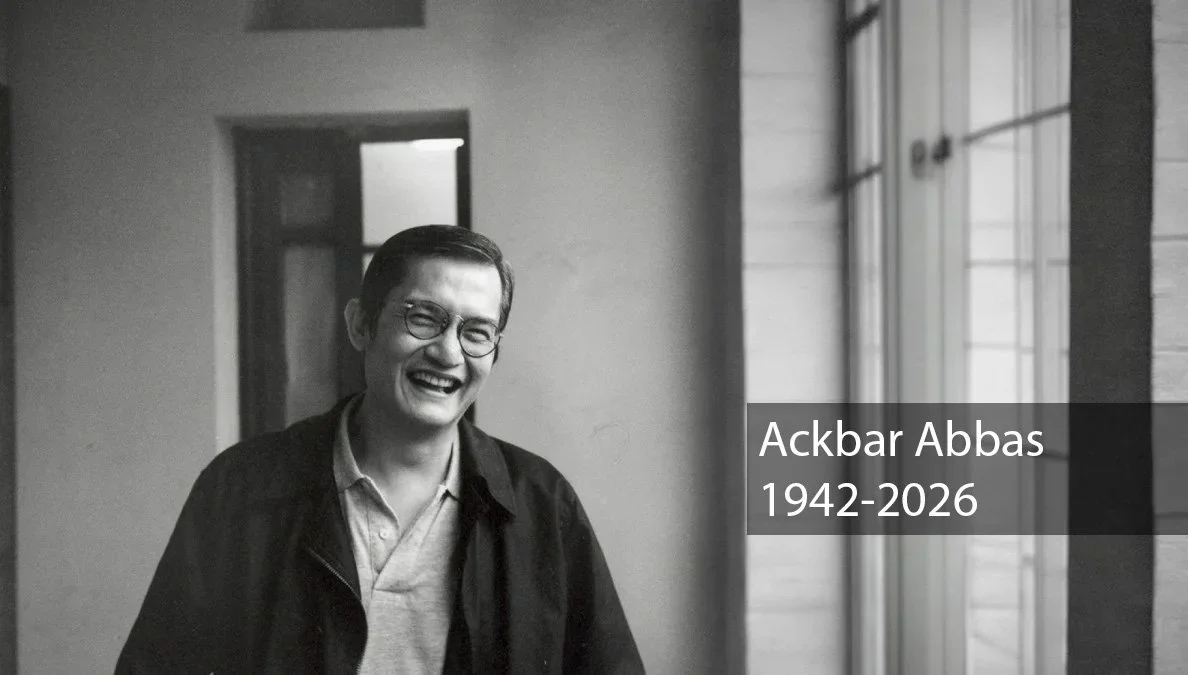
Professor Ackbar Abbas (b. 1942, Hong Kong) died peacefully in Beijing on 13 July 2026 after a brief period of illness. He is survived by his dear wife Sola, his children and grandchildren.
Ackbar will be remembered as a loving husband, a doting father, a devoted colleague, a special friend, and an inspiration to countless students and readers of his work over many distinguished years at Hong Kong University and the University of California, Irvine. A great thinker of fascination, connoisseur of the fake, master of the paradoxical turn — one of a kind.
Ackbar was closely associated with the CTS for more than three decades and served on its Board of Directors for several years. He will be deeply missed.
Capitalism: A Global History
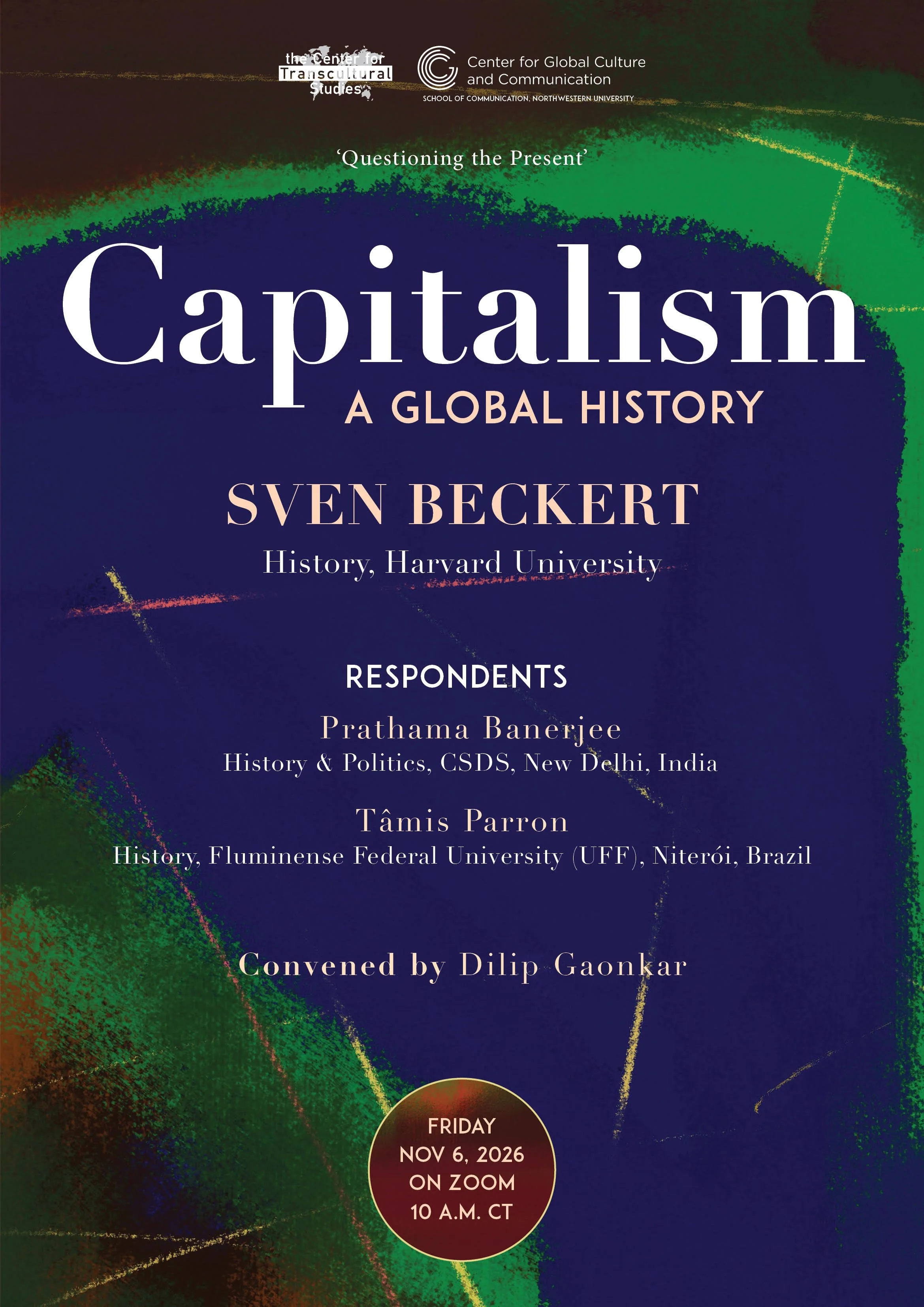
The Center of Global Culture and Communication
(An interdisciplinary initiative of Northwestern University's School of Communication) &
the Center for Transcultural Studies
(An independent intellectual network with institutional roots in Chicago)
Jointly present (Session 27) of
Questioning the Present, an online public forum on
Capitalism: A Global History
(Penguin, 2025) by
Sven Beckert
(History, Harvard University)
Respondents
Prathama Banerjee
(History & Politics, Center for the Study of Developing Societies (CSDS), New Delhi, India)
Tâmis Parron
(History, Fluminense Federal University (UFF), Niterói, Brazil)
Convened by Dilip Gaonkar
(Northwestern University)
ON ZOOM: Friday, November 6, 2026, 10 a.m. CST
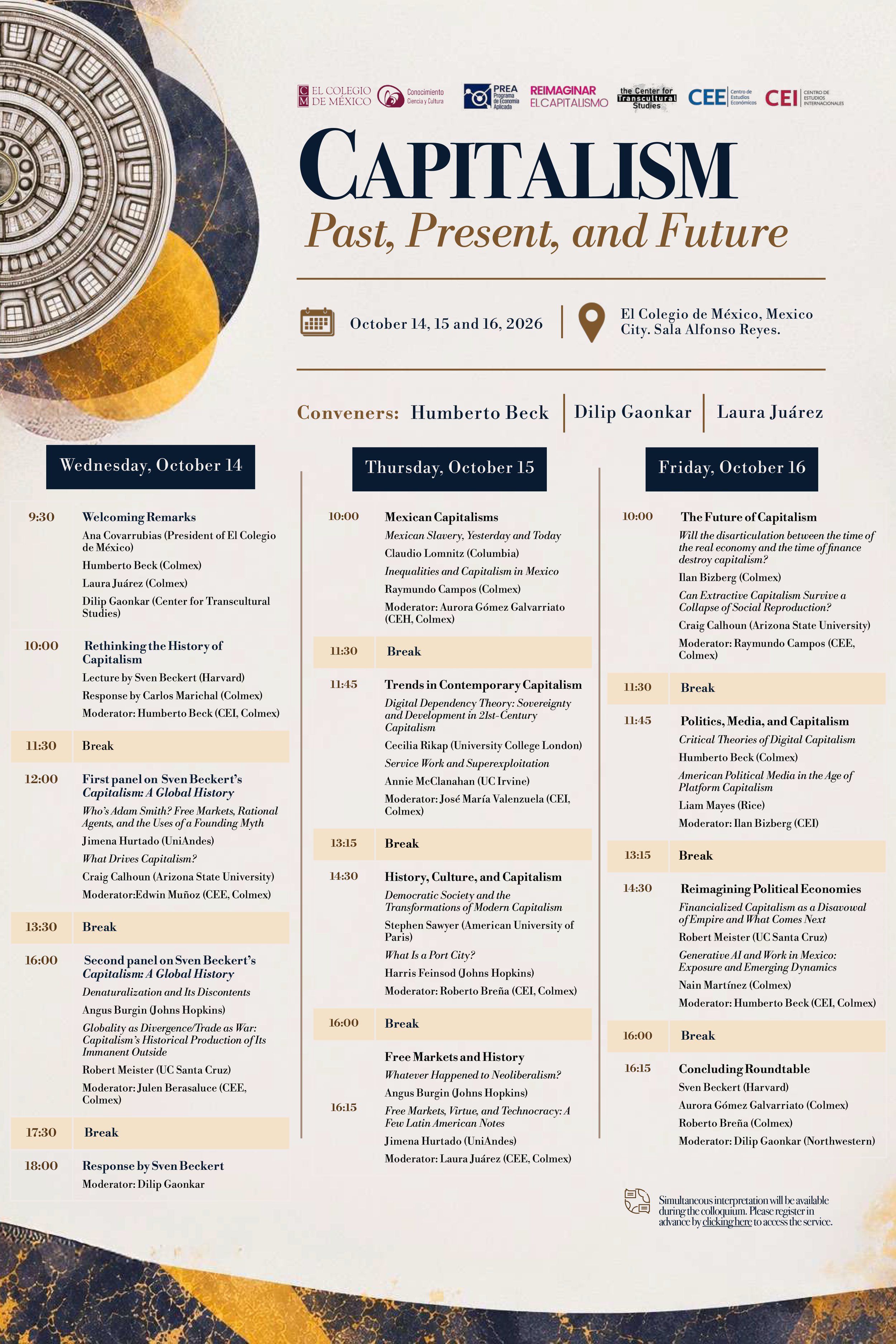
CAPITALISM: Past, Present, and Future
October 14—16, 2026 | El Colegio de México, Mexico City. Sala Alfonso Reyes.
Participants
Sven Beckert (Harvard)
Humberto Beck (Colmex)
Julen Berasaluce (CEE, Colmex)
Ilan Bizberg (Colmex)
Roberto Breña (CEI, Colmex)
Angus Burgin (Johns Hopkins)
Craig Calhoun (Arizona State University)
Raymundo Campos (Colmex)
Harris Feinsod (Johns Hopkins)
Dilip Gaonkar (Center for Transcultural Studies)
Aurora Gómez Galvarriato (CEH, Colmex)
Jimena Hurtado (UniAndes)
Laura Juárez (Colmex)
Claudio Lomnitz (Columbia)
Carlos Marichal (Colmex)
Nain Martínez (Colmex)
Liam Mayes (Rice)
Annie McClanahan (UC Irvine)
Robert Meister (UC Santa Cruz)
Edwin Muñoz (CEE, Colmex)
Cecilia Rikap (University College London)
Stephen Sawyer (American University of Paris)
José María Valenzuela (CEI, Colmex)
Conveners
Humberto Beck (Colmex) | Dilip Gaonkar (Center for Transcultural Studies) |
Laura Juárez (Colmex)
Featured Projects

The Questioning the Present project was launched in 2020 as a response to the contemporary political, economic, and social conditions in light of the COVID-19 crisis.

In 2017, the CTS launched a new network-building project titled Democratic Agendas Network as a framework for integrating projects and dialogues related to the career of democracy and its futures.

This program is co-funded by the Open Society Foundation, the CTS, the Center for Global Culture and Communication, and the Buffett Institute of Global Affairs (Northwestern University).
Publications
Public Works
Public Works is the CTS's international publications project. It includes the contemporary paperback series Public Planet Books (a collaboration with Duke University Press) and CTS-sponsored books. Benjamin Lee is Public Works' executive director.
Working Papers
Dig into the CTS’s intellectual history by checking out the working papers that CTS-affiliated scholars wrote between 1986 and 1992.